The restoration of Griselda and her children
The Canterbury TalesThe restoration of Griselda and her children brings the long ordeal of Walter and Griselda to its decisive reversal. Walter has repeatedly tested Griselda's constancy, removed her children, and finally forced her to accept the appearance of repudiation and expulsion. The restoration changes every value that had governed the preceding trials: humiliation becomes honor, apparent bereavement becomes reunion, and the powerless wife is returned to the household not as a discarded woman but as Walter's acknowledged only wife.
The Crisis Before Restoration
The event follows Walter's renewed testing of Griselda. The marquis continues, in what the narrative calls his wicked habit, to test her after all she has already suffered. His conduct has made her position precarious: she has been required to surrender one child and then another, and she has been made to believe that Walter will replace her with a younger bride. The restoration therefore does not arise from a minor misunderstanding. It answers a sustained sequence of ordeals in which Griselda's marriage, motherhood, social standing, and material security have all appeared to be taken from her.
The immediate setting is the arrival of the Earl of Panik from Bologna, news that spreads through the court and supplies the occasion for Walter's final public maneuver. Walter orders that the maiden who is supposedly to marry him be received the next day with extraordinary display. His command turns private cruelty into a staged social event: witnesses are gathered, ceremony is prepared, and Griselda's apparent displacement is made visible to the community.
Walter Reveals the Hidden Family
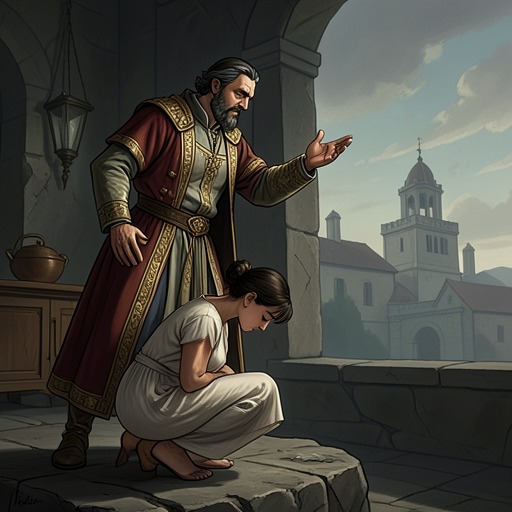
Walter's reversal begins when he addresses Griselda directly. He tells her that his firm will is for the maiden to be met with a grand array, but the public preparation conceals a truth that Griselda has not been permitted to know. He does not intend the maiden to become his wife. Instead, the girl is the daughter Griselda had believed lost and had imagined was being brought forward as Walter's bride.
Walter then discloses the second part of the secret: the other child, whom Griselda had also thought removed from her, has been preserved as he always intended and is to be his heir. The daughter and son have therefore survived the apparent destruction of Griselda's family. Their concealment was part of Walter's plan to discover the full extent of her obedience and will, although the revelation also exposes the severity of the power he has exercised over her.
Griselda's Response and the Reunion
When Griselda hears the truth, the accumulated grief of the trials gives way to overwhelming joy. She faints from the force of that joy; when she rises, she calls her son and daughter to her side and takes them into her arms. The gesture is the physical center of the restoration. Information that had previously existed only as rumor, threat, or absence becomes embodied in the children standing before their mother.
The scene joins revelation to recognition. Griselda does not merely learn that the children are alive; she sees them, summons them, and embraces them. The family that Walter's tests had made to seem irrecoverable is restored through direct reunion. The narrative thus converts the children from hidden objects of Walter's authority into visible participants in the recovery of their maternal bond.
Walter also ends the marital uncertainty. He tells Griselda that she is and will remain his only wife, invoking God's grant of eternal life as the seal of his declaration. The statement restores her legal and domestic identity after he has publicly treated her as a woman to be replaced. Yet it also preserves the troubling asymmetry of the episode: Walter controls both the ordeal and its conclusion, deciding when the concealed truth may be released and when Griselda may receive her family back.
Public and Domestic Reordering
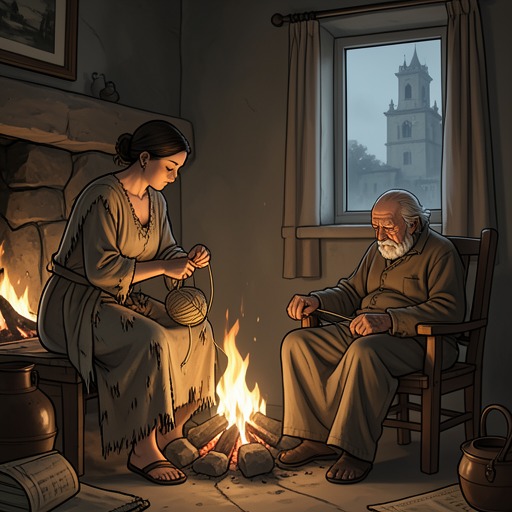
The restoration moves from the public court to the intimate chamber. The ladies take Griselda away at the proper time, remove her torn and tattered clothes, and prepare her for renewed dignity. Her clothing records the material consequence of Walter's repudiation: she has been reduced to the appearance of the poor woman from whom he first took her. Changing those garments reverses that visible degradation and marks her return to her place within the marquis's household.
The restoration is consequently both emotional and ceremonial. The daughter's survival secures the truth of Walter's declaration, while the son's designation as heir repairs the dynastic future. Griselda's restoration repairs the marital household, and the ladies' attendance converts that repair into a socially legible reinstallation. The court is invited to see happiness restored between husband and wife, while the family reunion supplies the private substance behind the public spectacle.
Narrative and Thematic Significance
The event resolves the story through a reversal from apparent death and abandonment to life, recognition, and belonging. Griselda's patience remains unbroken even after Walter has repeatedly wronged her; the narrator emphasizes that she shows no malice and remains cheerful under adversity. Walter, confronted by that constancy, feels pity for her wifely steadfastness and declares that the testing has gone far enough. Her endurance is therefore the immediate moral pressure that brings the hidden truth into the open.
At the same time, the restoration is deliberately double-edged. It confirms Griselda's extraordinary patience, but it does not erase the coercive structure that made such patience necessary. Walter's announcement that he had preserved the children secretly until he knew her every purpose presents concealment as proof of his authority and as the mechanism of the test. The family is restored, yet the reader must measure the happiness of the ending against the suffering that produced it.
The episode also gives the narrative a formal pattern of separation, concealment, revelation, and reintegration. Griselda has been separated from her children and expelled from the status of wife; the children have lived in secrecy; the truth is disclosed in a public setting; and the family is reunited through embrace, declaration, and renewed clothing. The final image is therefore not simply that of Walter's forgiveness. It is the visible reconstitution of a household whose members had been deliberately made strangers to one another.